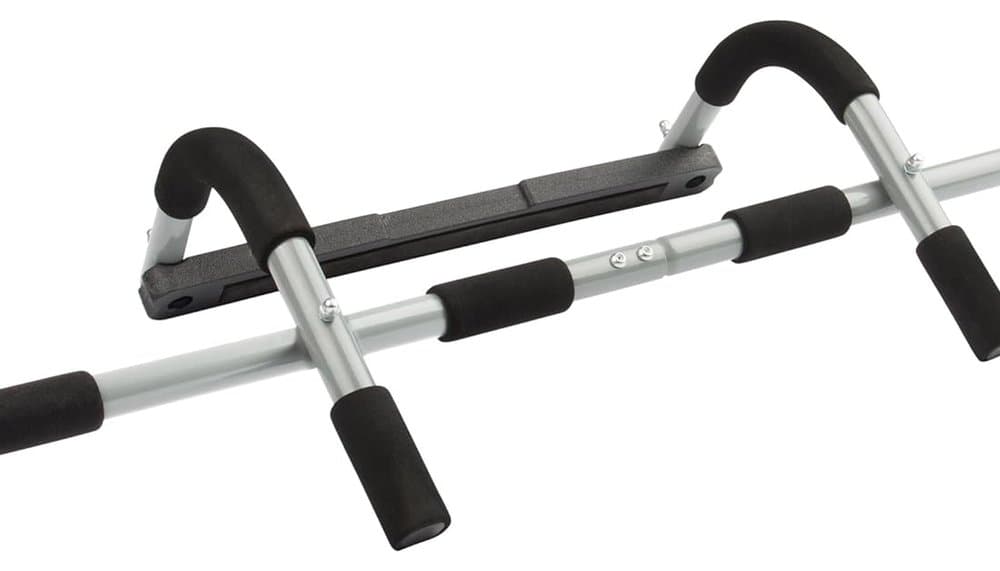
In the world of functional fitness and HYROX, where training aims to simulate the brutal demands of competition, every piece of equipment must pass a simple litmus test: is it up to the task? The Ultrasport Door Frame Pull Up Bar presents itself as an accessible, no-drill, and versatile home training solution. But between the manufacturer's promises and the reality of HYROX training, the gap can be large. We analyze this pull-up bar from the specific angle of our discipline: its ability to withstand intense fatigue, handle dynamic movement sequences, and effectively contribute to combined event preparation.
Strengths
On paper, the Ultrasport Door Frame Pull Up Bar has appealing arguments for an athlete concerned with practicality.
Its main asset is a no-drill installation, a real plus for renters or those who do not want a permanent installation. The promise is to be able to install and remove it in seconds on a standard door frame.
The construction is described as robust, with a steel frame and comfortable diameter foam grips (about 3 cm), offering different grips to vary back and arm work. Its advertised versatility is also a highlighted point, allowing for pull-ups, but also floor training for abs, triceps, and push-ups.
Weaknesses
However, upon closer analysis, especially through field feedback, structural weaknesses appear, particularly problematic in a HYROX context.
The most critical limit is the maximum load capacity of 80 kg. For a functional athlete audience, this limit is very restrictive and excludes a significant portion of practitioners, especially when considering that dynamic weight during a movement can exceed static weight.
The second major flaw is the limited compatibility with door frames. Many reports indicate that the hanging system requires a ledge of a certain thickness and depth, often absent on modern doors, making standard installation risky or even impossible without "DIY work."
Finally, where a HYROX athlete needs absolute confidence in their equipment, feedback often mentions a perceived lack of stability and relative safety, especially during somewhat dynamic executions or for users close to the weight limit.
Evaluating this equipment for HYROX means confronting it with the eight stations and the logic of the race. The answer is clear: the Ultrasport Door Frame Pull Up Bar is a tool very far from the demands of competition, and its usefulness in specific preparation is marginal.
First, let's examine its primary use: pull-ups. In HYROX, pull-ups are not a station, but upper body strength is crucial for the sled push, sled pull, and farmers carry. Pull-up training is therefore essential. However, testers and the community emphasize avoiding any ballistic or swinging movement on this bar. Yet, to develop explosive and enduring strength, the quality and safety of the bar are paramount. The 80 kg limit and concerns about stability make it a tool to be used with extreme caution, thus limiting progression and set intensity. One cannot afford to think about the bar moving during a max rep under fatigue.
Next, its advertised versatility for floor work (push-ups, abs) must be put into perspective. For a HYROX athlete, burpees are a key station. Using the grips for burpees could be interesting to vary angles, but the need to position the bar on the floor and constantly move it disrupts the flow of a high-intensity circuit. During a typical training session chaining running, rowing, and strength exercises, one needs fixed or quickly accessible equipment. The logistics of having to unhook, reposition, and re-check the stability of this bar at every transition is antithetical to the HYROX spirit where fluid and fast transitions are trained.
Finally, the most important point: safety and confidence. After a rower or running station, fatigue sets in, coordination decreases. It is at this moment that the equipment must be most reliable. User reports mentioning falls or a feeling of insecurity, even on compatible doors, make it a poor candidate for sessions where one pushes their limits. In a garage or dedicated room, one would without hesitation prefer a stable pull-up tower or a fixed wall-mounted bar which can support dynamic movements, kipping pull-ups (even if not in the HYROX program), and offer a base for other more relevant exercises like dips.
Technical Specifications
Characteristic
Detail
Model
Ultrasport Door Frame Pull Up Bar
Mounting Type
Door, no-drill
Main Material
Steel, foam
Max Load
80 kg
Frame Compatibility
Width: 61 to 81 cm max. / Depth: 12 to 16 cm
Grip Diameter
About 3 cm (foam)
Product Weight
1.68 kg
Product Dimensions
50 (L) x 21 (H) x ~17 (D) cm
Advertised Versatility
Pull-ups, floor exercises (push-ups, abs)
What Users Say
The synthesis of several hundred customer reviews and online expert feedback paints a clear consensus, with positive points but also recurring and significant reservations.
Recurring positive points:
Value for money: Many users find it acceptable for the price.
Perceived sturdiness: Once correctly installed on a compatible frame, the steel structure is judged robust by several users.
Practical idea: The concept of a removable, no-drill bar is popular in theory.
Frequent criticisms and problems:
Major compatibility problem: This is the number one point of friction. Many buyers report that their standard door frames are not compatible because they are too thin or lack the necessary ledge. The manual mentions a depth of 12-16 cm, which is often greater than the reality of modern frames.
Installation requiring "DIY work": Faced with this problem, part of the community has developed a solution: fixing a wooden or PVC batten above the door with screws to create the missing ledge. While this trick works (a 90 kg user uses it this way), it transforms the "no-drill" product into a semi-permanent installation requiring tools and skills.
Feeling of insecurity: Even on seemingly compatible doors, users note a lack of confidence, a bar that "moves" or "comes off". One review even specifies that dynamic use caused a fall due to a door ledge that was too thin (1.1 cm instead of the estimated minimum 1.5 cm).
Handicapping weight limit: The 80 kg limit is often cited as a strong limitation, effectively excluding many adult male athletes.
Variable finish quality: Some report screws deforming when tightened, plastic parts that seem fragile ("the Z-hook can bend"), or sometimes difficult assembly due to tight tolerances.
Conclusion
The Ultrasport Door Frame Pull Up Bar is a product that meets a specific need: that of a beginner or a very budget-conscious person, looking to do basic pull-ups at home in a dwelling whose door frames are perfectly compliant with the technical requirements (depth >12 cm). Within this very limited framework, it can be useful.
On the other hand, for a serious functional fitness and HYROX athlete, this bar presents too many compromises to be recommended as a main tool. The 80 kg weight limit is prohibitive, the recurring compatibility problems with doors add unnecessary friction, and the lack of absolute stability goes against the imperatives of safety during intense and fatiguing training sessions. It does not allow for simulating the reliability and robustness of competition equipment.
If your goal is to prepare for HYROX, investing in a stable pull-up tower or a fixed wall-mounted bar capable of supporting much higher loads and offering a base for more complete work (dips, knee raises) is a much wiser and safer long-term choice. The Ultrasport Door Frame Pull Up Bar remains, at best, a supplementary piece of equipment to be used with great caution.
100% free and independent — All our articles are written independently, without any sponsorship. We may receive a commission if you make a purchase through our links, at no extra cost to you.