In the demanding world of HYROX, where every second and every heartbeat counts, tracking physiological signals is not a luxury, it's a strategic tool. Between running, burpees, pull-ups, and sled pushes, understanding how your body recovers and adapts to the workload is crucial. The pulse oximeter has thus become a complementary piece of equipment for many athletes. But are all models suited to the extreme conditions of a HYROX competition or dedicated training? Today we analyze the Beurer PO 30 Digital Pulse Oximeter from this precise angle, breaking down its specifications and community feedback to determine if it can be a reliable ally in your preparation.
Key Strengths
Based on technical specifications and user feedback, several strengths of the Beurer PO 30 stand out for a functional fitness practitioner.
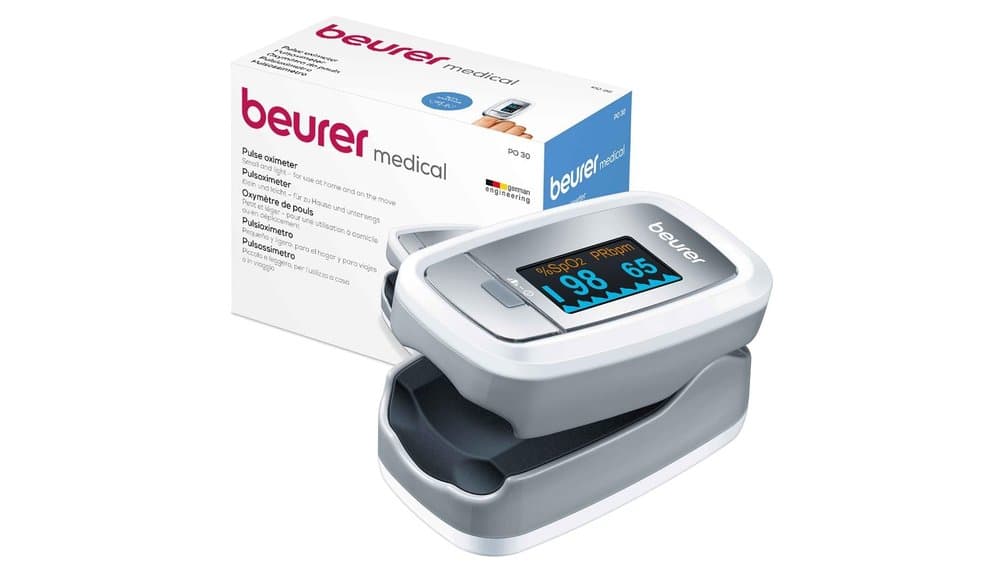
Simplicity and speed of use are highly praised. The device has only one button: you insert your finger, press, and the measurement displays in a few seconds. This immediacy is a major advantage in a HYROX context, where time between stations is limited and you want a quick reading of your recovery heart rate.
Its compact and lightweight format (57g, 6.1 x 3.6 x 3.2 cm) is also a significant asset. It can easily slip into a sports short pocket or an equipment bag. The inclusion of a wrist strap and a carrying case is regularly highlighted by users, allowing you to keep it within reach without the risk of losing it in the hustle and bustle of an event.
The color screen with automatic orientation is a detail that matters. After a Farmer's Carry where your hands are tired, or during a hurried reading, the display reorients itself to remain readable no matter how you hold the device. The extended heart rate measurement range up to 250 bpm widely covers the maximum heart rates reached during intense efforts, which is essential for our practice.
Weaknesses
Upon analysis, certain shortcomings or limitations appear, particularly from the perspective of advanced athletic use.
The lack of a Perfusion Index (PI) is the most significant weak point. This index provides information on signal quality and the strength of blood circulation at the fingertip. After a station like the Sled Push or Sled Pull, where the hands are subjected to significant pressure and congestion, peripheral circulation can be temporarily impaired. Without a perfusion index, it is impossible to know if the displayed SpO2 measurement is reliable or potentially skewed by poor local circulation, a phenomenon possible in a state of extreme fatigue and vasoconstriction.
The device lacks internal memory or connectivity. For a HYROX athlete wanting to track the evolution of their oxygen saturation and recovery heart rate over several weeks of training, this forces manual recording of each value, which is impractical and prone to error. It is a tool for instant measurement, not longitudinal tracking.
Finally, although the build quality is generally considered good, some feedback notes that the battery compartment finish can seem fragile. In the rough environment of a fitness box, with moving and falling equipment, its all-terrain ruggedness is not its main selling point.
Let's now evaluate how the Beurer PO 30 performs against the specific requirements of a HYROX competition or training.
During effort: limited utility. It is clear that this oximeter is not designed to be used while moving. The measurement requires finger immobility for several seconds to be reliable. Its use is therefore limited to recovery periods, immediately after a station or at the end of a training session, to assess how quickly the heart rate drops and oxygen saturation is restored.
The test of sweat and stressed hands. This is the real test. Users report generally good reliability, but the community highlights a critical point: for an accurate reading, the finger must be clean, dry, and warm. However, during a HYROX, hands are sweaty, sometimes chalked, and often congested or numb from carries (Farmer's Carry, Sandbag) or pull-ups. Under these conditions, even with a well-positioned finger, the measurement may take longer to establish or be potentially less stable. The lack of a perfusion index, let's remember, prevents checking this crucial point in the moment.
A tool for post-training monitoring and altitude acclimatization. This is where its "simple and reliable" profile shines. After a hard session, it allows for a quick check. Furthermore, for athletes training or doing camps at altitude, it is a valuable and easy-to-transport tool for monitoring oxygen saturation (SpO2) and ensuring good acclimatization, a relevant aspect for endurance performance.
Comparison with HYROX demands. HYROX tests resilience and the ability to chain intense efforts under cardiorespiratory stress. An ideal oximeter for this use should therefore:
Provide an ultra-fast and reliable measurement even with disturbed micro-circulation.
Indicate the reliability of the measurement via a perfusion index.
Be extremely rugged (shocks, sweat).
Be able to record data for post-competition analysis.
The Beurer PO 30 excels on points 1 (under normal conditions) and 3 (to a certain extent), but has shortcomings on points 2 and 4. It is an excellent consumer-grade oximeter that can provide occasional service to the athlete, but it is not a tool specifically designed or optimal for high-intensity monitoring.
Technical Specifications
Characteristic
Detail
Measurements
Oxygen Saturation (SpO2), Heart Rate (Pulse)
SpO2 Measurement Range
70% to 100%
SpO2 Accuracy
± 2% (between 70% and 100%)
Pulse Measurement Range
30 to 250 beats per minute (bpm)
Pulse Accuracy
± 2 bpm
Display
Color screen, automatic orientation, 4 display formats
Power Supply
4 AAA batteries (included)
Battery Life
Approximately 50 hours
Dimensions
61 x 36 x 32 mm
Weight
57 grams (without batteries)
Included Accessories
Wrist strap, Carrying case
Warranty
5 years (according to the manufacturer)
What Users and Testers Say
The synthesis of thousands of customer reviews and available online analyses paints a clear consensus.
The recurring positive points confirm our observations: the perceived reliability of the measurements is the primary reason for satisfaction ("gives the same results as at my pulmonologist's", "fast and accurate measurements"). The ease of use ("one button", "intuitive") and portability ("compact", "lightweight", "perfect for travel") are unanimously praised. The screen readability and automatic orientation are also highly appreciated.
The mentioned criticisms and limitations align with the identified weaknesses. Several users note the absence of advanced features like a perfusion index, memory, or alarms. The perceived fragility of the battery cover is reported. Finally, as experts point out, its use requires certain conditions to be met (warm finger, immobility) for an optimal reading, a constraint to keep in mind after intense effort.
The exceptionally high overall rating (4.6/5 across tens of thousands of reviews) testifies to a product that perfectly fulfills its primary mission for the general public and light medical monitoring. Disappointments often stem from expectations for features it simply does not have.
Conclusion
The Beurer PO 30 Digital Pulse Oximeter is a product of very good quality, reliable and intuitive for the purpose it is designed for: domestic or mobile use for occasional checking of oxygen saturation and pulse.
For the HYROX or functional fitness athlete, the analysis is nuanced. It is a useful tool, but with significant reservations. It can give you a quick indication of your heart rate during immediate recovery or accompany you during an altitude training camp. Its main asset in this context is its simplicity and speed of use.
However, its lack of a perfusion index and its absence of memory relegate it to the rank of a basic tool. If your goal is a detailed analysis of your cardiac recovery and oxygenation specifically under intense fatigue and after exercises that stress the hands, its limitations can be bothersome. For in-depth training tracking, models with connectivity (even more expensive) will likely be more suitable.
In summary, the Beurer PO 30 is a good choice for occasional and general use in your sports practice. But if you are looking for a high-performance measurement and tracking instrument specifically dedicated to the demands of high-level functional training, it shows its limits. It does its job well, but its job is not specifically designed for the extreme conditions of HYROX.
100% free and independent — All our articles are written independently, without any sponsorship. We may receive a commission if you make a purchase through our links, at no extra cost to you.