You are preparing for HYROX and you think a jump rope is just a jump rope? Big mistake. The wrong choice can cost you precious seconds and turn your event into an ordeal. I will explain how to choose this tool which should become a natural extension of your movement, not an obstacle.
Key Points to Remember
- Choosing the right jump rope for HYROX is strategic: it allows you to save time and conserve valuable nervous energy.
- For most athletes, the ideal combo is a medium/heavy weighted steel cable with sealed bearings for reliability.
- Set your rope shorter than the classic method (handles at hip level) for a more efficient and faster movement.
- Adapt your rope to your level: prioritize weight and feel for beginners, and speed with high-performance bearings for progression.
- Handles with good grip and a smooth rotation system are essential for maintaining control under fatigue.
Why the Right Equipment Changes Everything in HYROX
You might think that after the burpees and the sled push, the HYROX jump rope is just a formality, a moment to catch your breath. Frankly, that's one of the biggest strategic mistakes I see. This station is either a pure opportunity to gain time, or conversely, a trap that will needlessly exhaust you and ruin your rhythm for what comes next. The difference isn't just about your cardio, it's in your hands, with the tool you've chosen.
The Rope as an Extension of Your Movement
Imagine the scene: you arrive at the station, heart pounding, legs heavy. You grab a rope that's too light and hyperactive, you have to put in a huge coordination effort just to avoid tripping. Conversely, a rope that's too heavy and sluggish will drain energy from your shoulders with every rotation. What you need is a rope that "spins on its own" once started, with a weight and inertia that match your target pace. A good rope for HYROX allows you to find a regular, economical, almost meditative tempo, where you focus all your energy on the jump itself, not on handling the object. That's the difference between enduring the event and controlling it.
The Hidden Cost of a Poor Choice
Let's talk numbers and fatigue. Over 100 double-unders (the standard in HYROX), with an unsuitable rope, you'll probably make 10, 15, even 20 mistakes. Each mistake is a stop, a restart, a disruption of your breathing, and a mental drain. It can easily add 30 seconds to 1 minute to your total time. Now, multiply that by the number of stations in the race... the bill adds up. And it's not just a question of time, it's a question of nervous fatigue. Fighting your equipment is the best way to drain your mental energy before the strength events ahead. Your rope should be an ally, not an additional opponent.
My opinion? Too many athletes neglect this piece of equipment by telling themselves they'll train with what they have. It's a false economy. Investing in the right jump rope for HYROX is as strategic as choosing your shoes. It doesn't make you a pro, but it keeps you from shooting yourself in the foot before you even start.
Weight, Materials, Bearings: The Decisive Trio
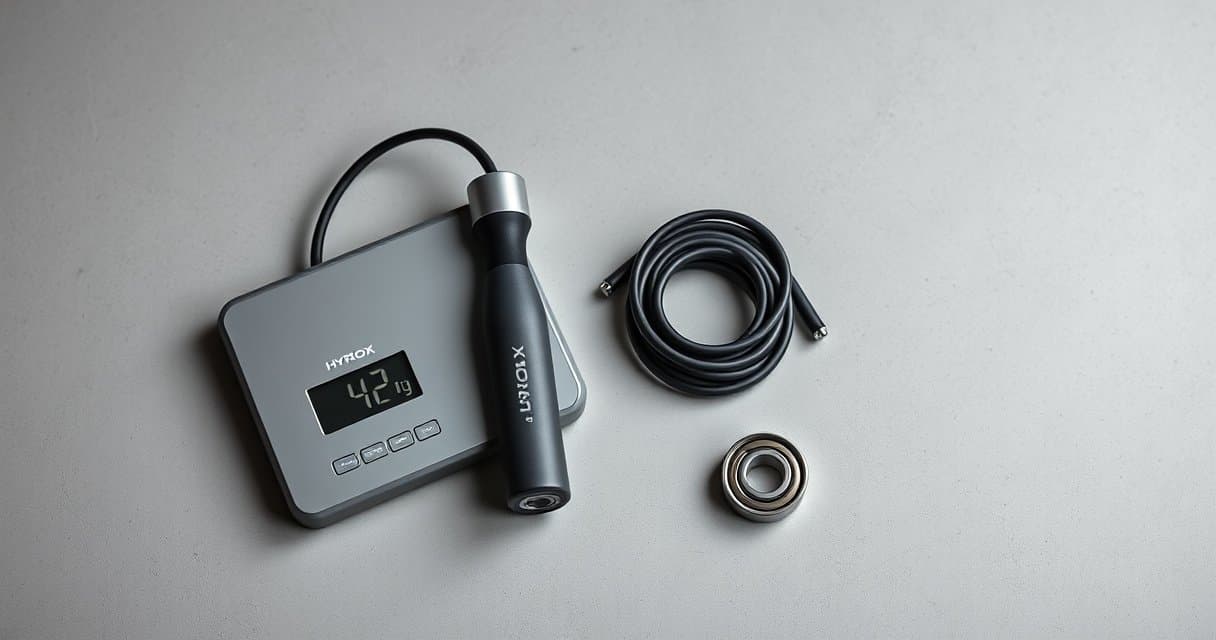
This is where it really matters. We're going to break down the technical specifications without unnecessary jargon, because understanding these three elements means understanding what will be spinning in your hands for 100 repetitions under pressure.
Weight: Between Speed and Feedback
The weight of the rope is generally measured at the cable itself. It's often discussed in grams per meter. A light rope (around 50-80g/m) is fast, lively. Perfect for highly technical athletes aiming for a frantic pace. But be careful: under HYROX fatigue, it can become difficult to control, to "feel". A heavier rope (100-130g/m) offers more inertia. It spins with less effort on your part, provides clear physical feedback with each pass. For the majority of practitioners, especially those who aren't rope specialists, a medium to heavy weight is a safer choice and less taxing on nervous energy. Frankly, unless you're a double-under expert, prioritize stability over pure speed.
Cable Materials: From PVC to Steel Cable
The feel and durability come from here.
- PVC (or plastic) coated: This is the entry-level standard. Flexible, light, inexpensive. It deforms easily if stepped on and can become "wild" after an impact. Okay for beginners, borderline for competition where consistency is key.
- Steel cable PVC coated: This is the workhorse for HYROX. The steel core provides unmatched rigidity and memory. Even after an impact, it returns straight. The PVC coating offers just enough flexibility on impact. This is the sweet spot for most: durable, predictable, with good feedback.
- Bare steel/copper cable: The weapon of purists. Ultra-fast, ultra-light, almost no air resistance. But it hurts when it whips you, and it forgives no technical error. I only recommend it to absolute experts who perfectly master their movement.
Bearings: The Invisible Pivot Point
This is the heart of the system, and often the first point of failure on a cheap rope. The handles must spin freely, without catching, so the energy from your wrist is fully transferred to the rope.
- Standard ball bearings: They do the job, but can become less smooth with dust, sweat. Some play may appear.
- Sealed (or shielded) ball bearings: Much better. They are protected from the elements. The rotation remains smoother, for longer. It's a sign of quality that often justifies a small extra cost.
- Needle bearings: The high-end. They support greater radial loads and offer exceptional smoothness. You literally feel it when you spin the handle: it's silent, oiled, without jerking.
Our Selection
Hey folks! We recently took a look at some jump ropes to boost our cardio sessions at home or outdoors. Honestly, it's a great tool for burning calories without breaking the bank and without taking up space. We tested three models that frequently come up in recommendations, and we're giving you our honest feedback, straight up. Here's a little table to compare the key features before we dive into the details.
| Product | Max Length | Cable Material | Handles | Key Strengths |
|---|---|---|---|---|
| Blukar Skipping Rope | 3.0 m | Steel coated in PVC | Memory foam | Durability, smooth rotation, generous length |
| GRIFEMA GA5004 | 2.8 m | Steel coated in PVC | Memory foam | Carrying bag included, simple adjustment, good balance |
| Wastou Speed Skipping Rope | ~3.0 m | Steel coated in silicone | Lightweight aluminum | Extreme lightness, speed, dual bearings |
Blukar Skipping Rope
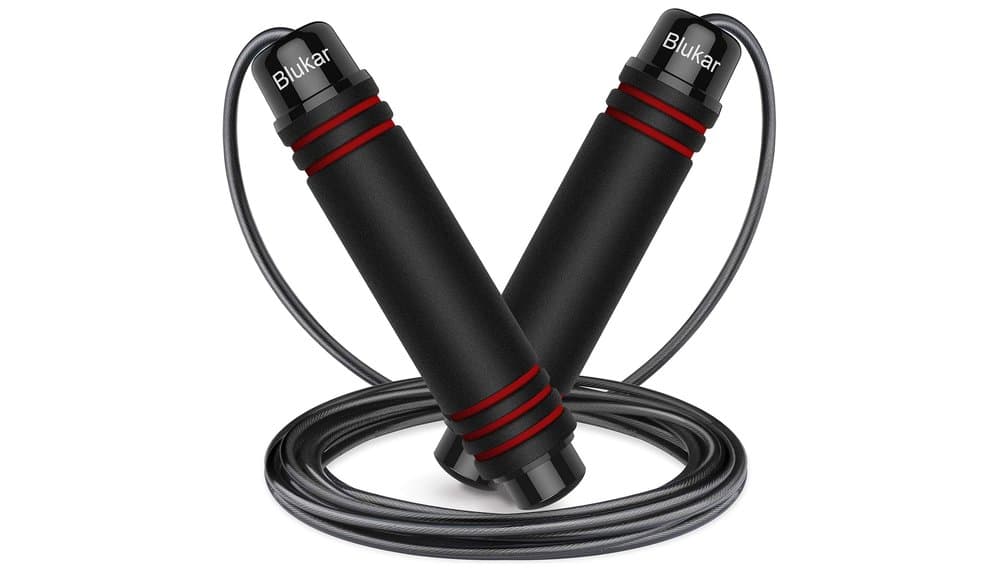
This Blukar rope is a bit like the dump truck of the selection: solid, reliable, and gives the impression it can handle years of intensive use. The steel cable coated in PVC is thick and seems truly unbreakable. What surprised us was the smoothness of rotation provided by the ball bearings; the rope passes through really smoothly, even when speeding up the pace for double unders. The memory foam handles are comfortable and offer a good grip, even with sweaty hands.
The major strength is its robustness and its very generous adjustable length (3 meters), which suits taller builds without issue. However, this sturdiness comes at a cost in terms of feel: the rope is a bit heavy. This isn't a problem for standard interval training, but for those seeking pure speed and very long sessions, it can tire the shoulders more quickly. Another point to note: some users report that the PVC coating on the cable can eventually crack after months of very intensive use and/or if it's often dropped on a hard surface. It's sturdy, but it's not indestructible.
GRIFEMA GA5004
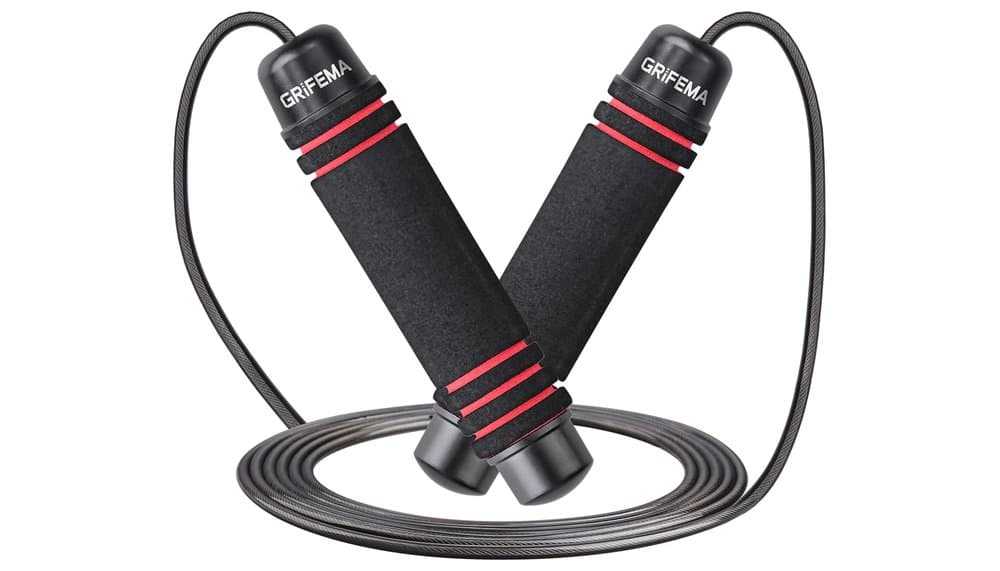
The GRIFEMA GA5004 is the ideal compromise in our selection. It shares many similarities with the Blukar (steel/PVC cable, foam handles, smooth bearings), but it brings a few practical little improvements that make a difference. First, it's slightly lighter in use, making it a bit more versatile. Secondly, and this is a real plus, it comes with a small carrying bag with clips to store the rope at its adjusted length. Handy if you carry it in your gym bag.
Its length adjustment is simple and effective, although you often need wire cutters to trim the excess cable, like on most models of this type. It rotates very well, but we noted that the cable can sometimes retain a memory of being folded straight out of the box; it needs a little time to fully relax. It's a rope that does the job very well, with no major flaws, but also without any particular standout feature. Perfect for regular, hassle-free use.
Wastou Speed Skipping Rope
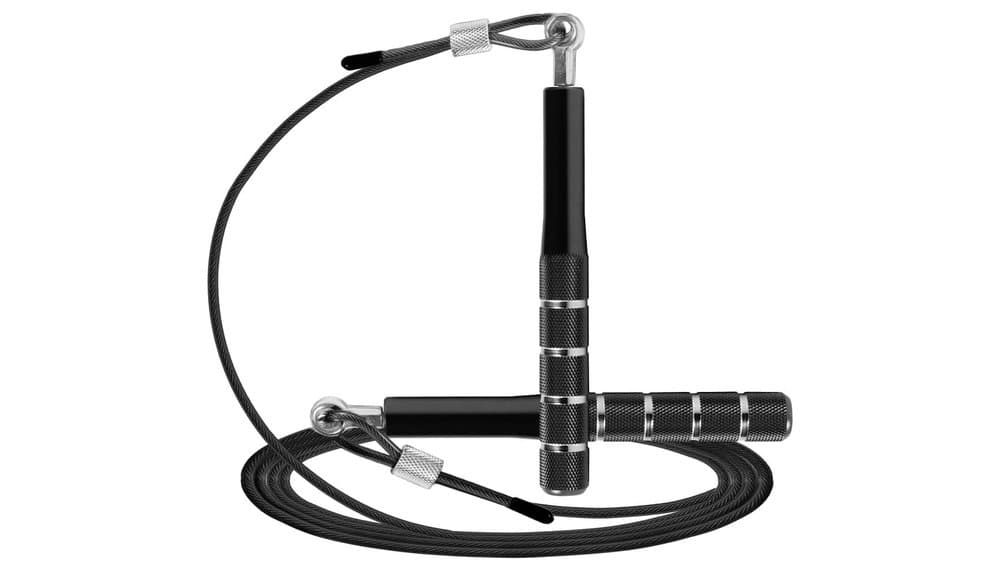
The Wastou is clearly the rocket of the trio. If you're aiming for speed, intense HIIT-style cardio, or boxing practice, this is the one to look at. Its main asset? Its extreme lightness. The handles are hollow aluminum and the cable is a thin steel coated in silicone. The result is that it moves at an insane speed and requires less effort from the arms and shoulders over time. The dual bearing system ensures a super smooth, snag-free rotation.
This gain in speed and lightness involves a few trade-offs. First, the in-hand feel is very different: less "weight" to manage, which requires a little adjustment time to get your timing right. Secondly, its thinness is also its weakness: if you miss, the metal cable can whip and hurt (be careful with children or when wearing shorts). Finally, although the cable is strong, the attachment points in the aluminum handles can be the weak link in the very long term according to some feedback. This is a rope for practitioners seeking performance, not for complete beginners or very "brutal" use.
Adjusting Length to Your Build (Practical Method)
This is likely the most common mistake: a rope that's too long. You know that image of the athlete having to spread their arms out horizontally to clear the rope? That's exactly what you need to avoid in HYROX. A rope that's too long slows you down, increases the risk of faults, and tires you out unnecessarily. A rope that's too short whips your ankles or skull with every jump. The correct length is the one that allows for efficient and compact movement.
The Basic Rule (And Why It's Often Wrong)
You often hear: "Hold the handles under your armpit, the loop should touch the ground." This is a good starting point, but it's a method for a general fitness or boxing rope. For HYROX, where movement efficiency is paramount, we generally aim for shorter. This "armpit" method often results in a length that forgives technical errors but does not optimize rotation speed. We can do better.
The Real "HYROX" Method: The Action Test
Put on your athletic shoes. This is important, as the sole alters your height.
- Starting Position: Stand in the middle of the rope, one foot slightly in front of the other.
- Adjustment: Bring the handles up to your hips. For an optimal length, the tips of the handles should reach about the level of your floating ribs, not under your armpits.
- The Decisive Test: Raise your forearms to a horizontal position, elbows close to your body (as if you were in the jumping position). The handles should point forward, and the loop of the rope should just skim the ground. No more.
- Validation in Motion: Do a few jumps. The arc of the rope should pass just a few centimeters above your head and under your feet. You should feel that the rotation is tight, controlled, and that the slightest movement of your wrists translates immediately.
A Dynamic Adjustment, Not a Static One
Does your build change? No. But your technique does. As you progress, as your double-unders become tighter and your wrist movement more efficient, you can – and should – shorten the rope slightly. Gaining 5 cm can gain you 10% in rotation speed. That's huge over 100 jumps. Don't consider the length as final on the day of purchase. It's an adjustable parameter.
Personal opinion: I see too many people in competition with a rope that slaps the ground with every turn. That's wasted energy and lost time. Tighten the movement, tighten the rope. You'll gain in effort economy, and that's what matters when you're transitioning after the rower or the burpees.
Grip and Rotation: A Matter of Feel and Efficiency
After length, this is where the choice becomes truly personal. You can have the perfectly sized rope, but if the handles slip from your hands in the middle of a set of double-unders when you're fatigued, it's a disaster. And the way the rope rotates will directly influence your energy expenditure. We're not talking about a gimmick, but pure mechanics.
Choosing Handles: Texture, Shape, and Weight
Forget smooth, glossy handles. In HYROX, your hands sweat, they might be dusty after the sandbags. A secure grip is non-negotiable.
- Texture: Look for handles with a textured surface, made of rubber or with an integrated grip. Some even have a slight diamond pattern that makes all the difference when the palm is sweaty. The goal is to be able to hold with a firm but relaxed grip, without having to squeeze like crazy.
- Shape: Test them! Some are thin and cylindrical, others are thicker and contoured to fit the palm. Ergonomic profiles can reduce forearm fatigue over time. But be careful, a large handle can be less agile for small wrists.
- Weight: This is a crucial and often underestimated point. Handles that are too light give a feeling of lack of control. Too heavy, and they tire the wrists and slow down the rotation speed. A good balance gives the rope inertia, which helps maintain a steady rhythm without constant effort. For me, handles between 80 and 120 grams each are often a sweet spot.
The Rotation System: What Are Bearings Really For?
This is the heart of the movement. The rope must rotate freely, without snagging, with minimal friction. This is what allows for minimal and precise wrist movement.
- Standard ball bearings: They do the job for occasional practice. But under the speed and repetition of a HYROX workout, they can heat up, lose fluidity, and become noisy.
- Sealed/swing ball bearings: This is often the standard on good fitness ropes. They are protected from dust and sweat, and remain fluid longer. It's the minimum to aim for.
- Needle bearings: Here, we move to a higher level. They offer a larger contact surface, better support radial loads (the tension of the rope), and rotate with an almost oiled fluidity at all times. The difference is felt immediately: the rope almost seems to move by itself after the wrist impulse. For someone aiming for pure efficiency and who hates the feeling of "grinding" or resistance, it's an investment that changes everything.
Frankly, if you've ever felt your forearms burning during jumps, part of the problem might come from a rotation that resists too much. Good mechanics allow you to concentrate your effort in the calves and shoulders, not in a fight against your own equipment.
From Beginner to Competitor: Making the Right Choice to Progress
There is a huge difference between buying a rope to learn double-unders and choosing one to explode your time on the SkiErg/Sled Pull station. Your current level and your goals should guide your purchase, otherwise you risk getting discouraged or stagnating. Don't skip steps.
For the Beginner: Priority on Mastery and Consistency
If double-unders are still a struggle, your worst enemy is the rope that tangles in your feet at the slightest timing error. You need tools that help you learn, not ones that punish you.
- Weight is your ally: Opt for a rope with a bit of weight, say between 150 and 250 grams for the rope alone. This extra weight creates better kinesthetic feedback — you feel the rope rotating around you. It slightly slows the rotation, giving you those precious milliseconds to adjust your jump. An ultra-light rope is too fast and unpredictable for beginners.
- Forgiving material: A PVC-coated cable or a slightly thicker braided rope is perfect. It maintains its arc shape at low speed, which is more predictable than a thin steel cable that can whip.
- The goal: Find a rope that allows you to do sets of 10, then 20 clean and controlled doubles. This is your foundation. At this stage, high-end bearings are an unnecessary luxury; reliability and feel are far more important.
For the Intermediate Athlete Aiming for Efficiency
You can string together 50 doubles without issue in training, but when fatigued, after a race, it falls apart. Your goal is to make the movement more economical and more resistant to pressure.
- Transition to speed: This is the time to switch to a lighter (100-180g) sheathed steel cable. You aim to reduce air resistance and slightly increase RPM (rotations per minute) without losing control.
- Invest in mechanics: Quality sealed ball bearings become essential. They ensure the rope spins as easily on the 100th jump as on the first, even with tired wrists. This is where you really need to pay attention to the rotation system we talked about earlier.
- The goal: Transform doubles from a technical exercise into an efficient active recovery tool during your circuit. Reduce variance: doing 30 doubles should require the same effort, whether you are fresh or exhausted.
For the Competitor: The Quest for Minimal Friction
Every watt of energy saved on the jumps is one more watt for the final sled push. Here, we optimize for pure performance, absolute reliability, and extreme customization.
- Ultra-light and aerodynamic: We're talking about very thin sheathed steel cables, sometimes under 90 grams. The goal is to minimize rotating mass and aerodynamic drag. The feel is almost immaterial; control comes from perfect technique and hyper-precise wrist flicks.
- Customization is king: The competitor doesn't settle for an "approximately good" length. They adjust down to the half-centimeter. They may have different ropes (slightly heavier/lighter) for specific sessions or depending on their form. The handles must be a perfect extension of their hand.
- The goal: Execute the 100 doubles in HYROX with metronome-like consistency and minimal energy expenditure. The rope must not be a performance factor, but a completely transparent tool, as reliable as your shoes. At this level, a rope that "lags" does not forgive.
Frankly, investing in a competitor's rope as a beginner is like putting F1 tires on a city car: it's counterproductive, unmanageable, and will slow you down more than anything else. Evolve your equipment with your skills.
Conclusion
So, now you are equipped to make the right choice. A HYROX jump rope is not an accessory, it is a piece of performance equipment. Think weight, length, grip. Test it. Make it your own.
Choose based on your current level, not your distant ambitions. A well-suited rope becomes a silent ally, disappearing to leave only your rhythm and your breath. Good reps.
Frequently Asked Questions
Which jump rope should I choose for HYROX?
For most HYROX practitioners, the ideal rope is one with a steel cable sheathed in PVC (for durability and feedback), of medium to heavy weight (for good inertia), and equipped with sealed ball bearings for reliable rotation under fatigue.
How to adjust the length of a jump rope for HYROX?
Hold the handles at hip level: the tips should reach the bottom of your ribs, and the loop of the rope should just brush the ground; this method, shorter than the classic "under the armpits," optimizes speed and control for double-unders.
Why is the weight of the rope important in HYROX?
The weight determines inertia and feedback: a rope that is too light (50-80g/m) is twitchy and difficult to control under fatigue, while a heavier rope (100-130g/m) spins more easily and offers a more stable feel, which conserves nervous energy during the event.
What are the best bearings for a competition jump rope?
For reliable performance in HYROX, prioritize sealed ball bearings (protected from sweat and dust) or needle bearings (high-end), which ensure a smooth and consistent rotation even during long series of double-unders under pressure.
How to choose a jump rope for starting double-unders?
A beginner should prioritize a rope with some weight (150-250g) and a PVC or braided cable, as this slightly slows the rotation and provides a better feel, making it easier to learn the timing without being too punishing.
100% free and independent — All our articles are written independently, without any sponsorship. We may receive a commission if you make a purchase through our links, at no extra cost to you.
Guides you might like
Home Gym Hyrox Guide
Start Hyrox training at home. A smart strategy to balance an active life and prepare for the competition efficiently.
Hyrox Dumbbell Buying Guide
Hyrox demands the right gear. Discover the key features for choosing competition-ready dumbbells to maximize performance and safety.
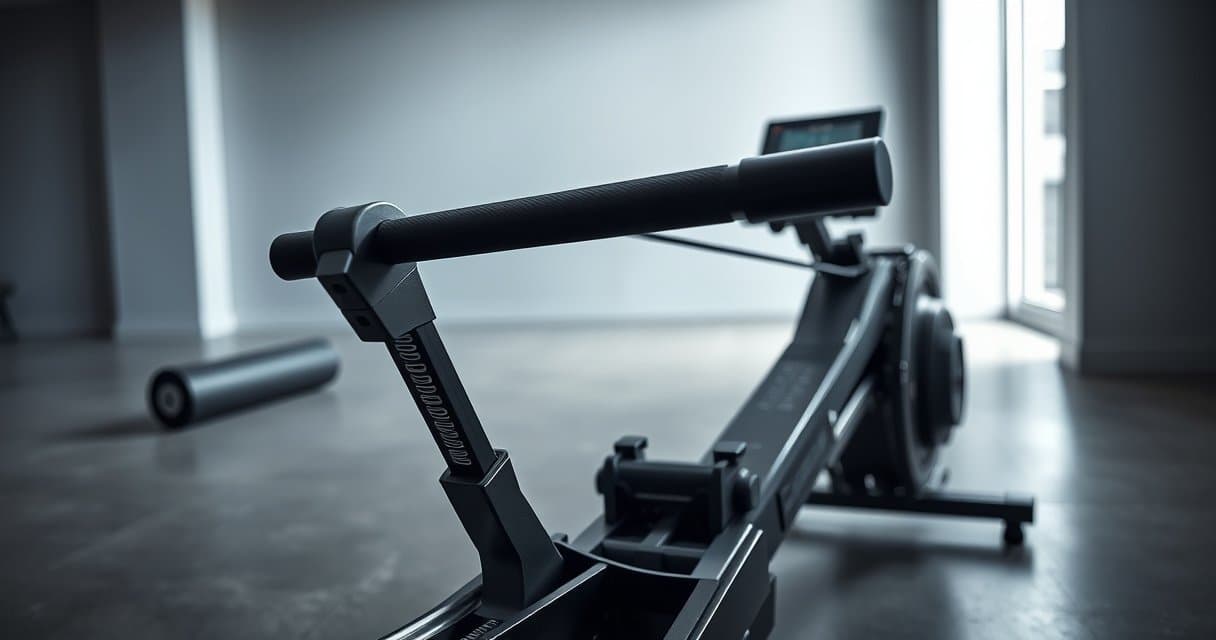
HYROX Rower Buying Guide
Choose a rower built for HYROX: prioritize raw air resistance or high-end magnetic models with watt display for brutal, repeatable performance.
You might also like
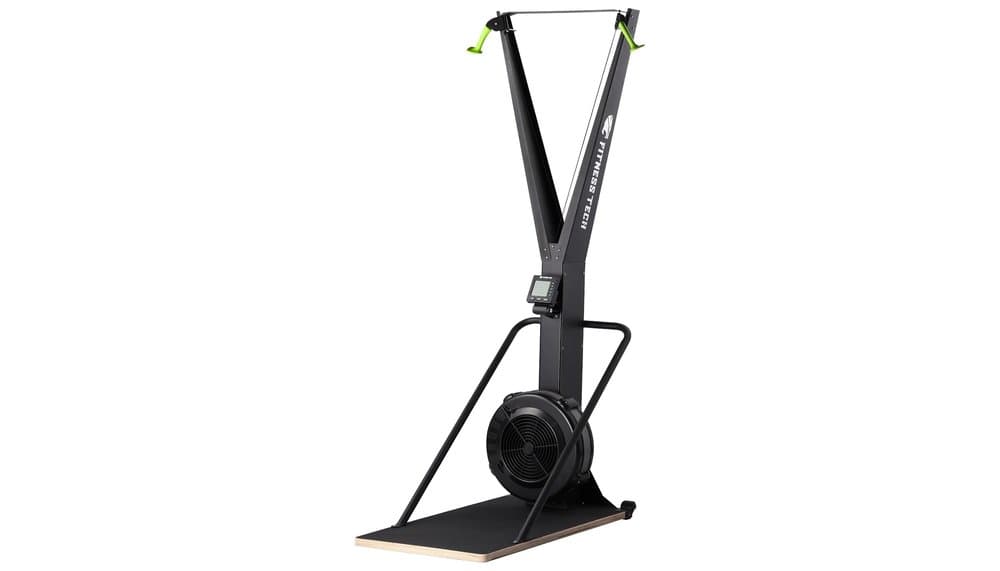
Fitness Tech Erg Ski Machine with Platform Review
Test the Fitness Tech Erg Ski Machine for HYROX training. Delivers intense cardio and full-body strength to boost competition performance.
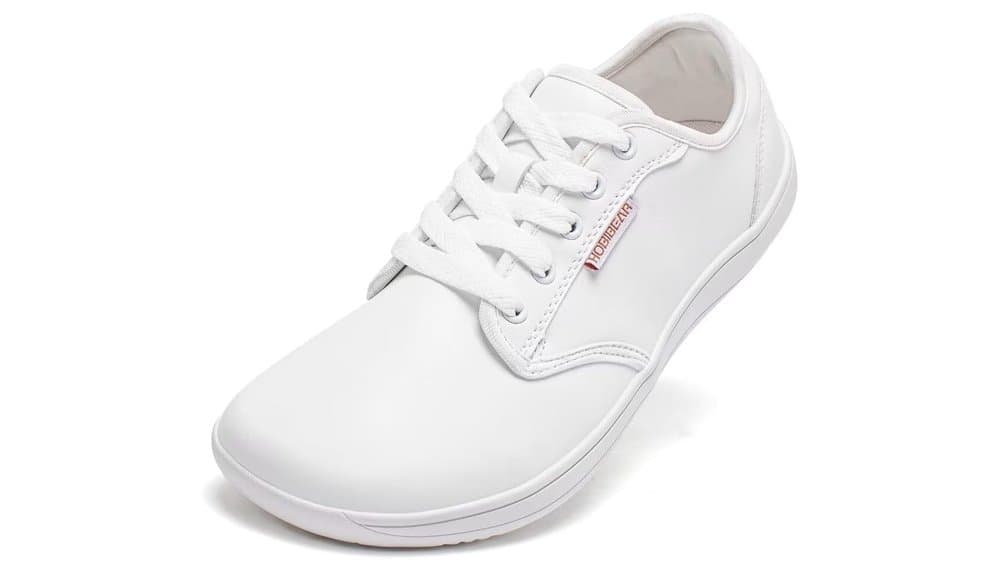
HOBIBEAR Barefoot Shoes Review & Test | Minimalist Sneakers
Test HOBIBEAR barefoot shoes in HYROX. Can minimalist design withstand 8km runs and 8 functional workout stations?

OMRON E3 Intense TENS Device Review
Portable TENS device for pain relief. Review of the Omron E3 Intense for managing muscle soreness and joint pain during HYROX training and recovery.