In the demanding world of HYROX, where endurance, strength, and muscular resilience are tested through eight functional fitness stations and 1 km of running, recovery is not a luxury, it's a tactical necessity. Self-massage tools, like rollers, have become indispensable allies for managing congestion, soreness, and maintaining mobility between training sessions and in competition. The TNOMSNO Massage Roller 30 x 8 cm enters the scene with a promise of practicality and effectiveness. But does this compact, textured format meet the specific demands of a HYROX athlete? We analyze this product from the perspective of running, rowing, burpees, and cumulative fatigue to determine if it deserves a place in your gym bag.
Strengths: Practicality and Targeted Muscle Action
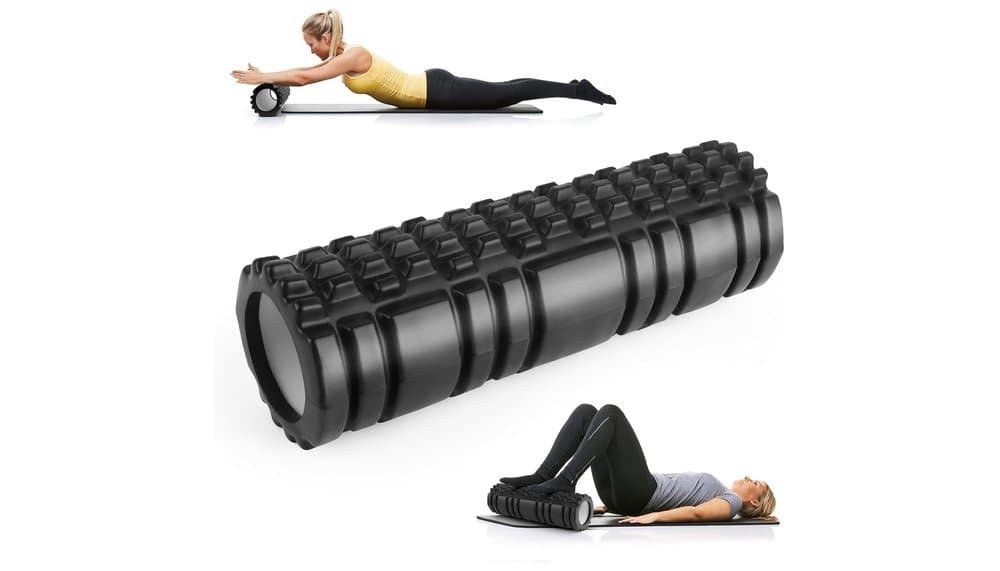
The first asset of this roller is its compact and portable format. At 30 cm in length and 8 cm in diameter, it's easy to slip into a gym bag already loaded with running shoes and accessories. For a HYROX athlete who travels to the box, gym, or competition, this size is an undeniable logistical advantage.
The second strength lies in its triple-texture surface. According to the manufacturer's specifications, the different reliefs are designed to mimic the pressure of palms, fingers, and fingertips. This translates, based on community feedback, into an ability to target tension points (or trigger points) with more precision than a smooth roller. For overworked muscles like quadriceps after sled pushes or hamstrings after farmers carries, this deep action can be beneficial.
Finally, the EVA material is generally recognized for its balance between firmness and durability. On paper, it promises not to deform over time, a crucial point for a tool subjected to repeated pressure.
Weaknesses: Stability Limits and Questioned Durability
The main weakness, consistently noted by users, concerns its limited length. Thirty centimeters can be restrictive for working on large muscle areas like the back or the entire hamstrings in one pass. The exercise becomes less fluid, requiring frequent repositioning, which can hinder the effectiveness of rolling during a quick recovery session.
The 8 cm diameter is also a point of discussion. Thinner than average (often 14-15 cm), it offers a more concentrated pressure, sometimes too intense. Several testers point out that this firmness and the aggressiveness of the nubs can cause discomfort, even marked pain for sensitive or unaccustomed individuals. This is clearly not a roller for beginners in self-massage.
Finally, serious doubts emerge regarding its long-term robustness under load. Several customer reviews report breakage of the internal plastic core after only a few uses, for users weighing around 100 kg, well below the announced limit. For a HYROX athlete, often powerful and heavy, this potential flaw is a deal-breaker.
Evaluating an accessory for HYROX means asking how it performs within the specific ecosystem of the competition: extreme fatigue, need for quick recovery between stations, and targeting the most stressed muscle groups.
Adaptation to specific events:
Running / Rowing: For tired calves, hamstrings, and back, the short format forces segmented work. It can be effective on a precise tension point in the calf, but impractical for smooth rolling along the entire posterior chain.
Sled Push / Sled Pull: The ultra-stressed quadriceps and glutes demand a stable roller with good length. Here, stability is compromised by the reduced diameter, and the length requires multiple repositionings.
Burpees / Farmers Carry: For shoulders, upper back, and forearms, the compact format becomes an advantage. It is more manageable for targeting small areas like the trapezius or rotator cuff muscles.
Behavior under fatigue and quick transitions:
This is where the problem lies. When fatigue is intense, fine motor skills decrease. Handling a short, thin roller on a painful, congested muscle requires increased control and balance. The temptation to apply too much pressure to quickly "undo" the muscle can lead to approximate and counterproductive technique, increasing the risk of bruising (as reported by one user) or injury.
Comparison with the demands of a HYROX competition:
A HYROX athlete needs robust, reliable, and effective tools. Recovery is part of performance. The doubt about the durability of the TNOMSNO Massage Roller places it behind models known for their solidity. Its format is ideal for nomadic use and spot targeting, but it cannot be the main myofascial recovery tool for a serious athlete. It would rather be a complementary accessory to a long, smooth roller, reserved for precision work on specific areas before or after effort, but not for deep recovery of large muscle groups.
Technical Specifications
Characteristic
Detail
Product Name
TNOMSNO Massage Roller
Dimensions
30 cm (length) x 8 cm (diameter)
Weight
0.4 kg
Material
EVA foam (Ethylene Vinyl Acetate)
Firmness
Advertised as "Medium" (reviews describe it as firm to hard)
The synthesis of 101 customer reviews (average rating 4/5) and expert feedback from the web paints a mixed picture.
Positive trends confirm some strengths:
Perceived Effectiveness: Many users find it "great," effective for knots, and fulfilling its massage role well.
Portability: Its "compact" and "easily transportable" format is widely praised.
Value for Money: At purchase, it is often perceived as a good deal.
Recurring criticisms raise concrete problems:
Durability Issues: Several reports mention breakage of the internal core after few uses ("already the first day," "about 5 uses"). This point is alarming for a sporting audience.
Hardness and Discomfort: Terms like "too hard," "bad feeling," "shape not adequate" recur. One user, presenting as a powerlifter, even reports getting "bruises" on their back.
Deformation: One review notes it can retain a "slight flat spot" after use, calling into question the promised non-deformation.
Limiting Size: Even overall positive reviews note it is "a bit cumbersome" to use, likely due to the reduced length.
Conclusion
The TNOMSNO Massage Roller 30 x 8 cm is a double-edged sword from a HYROX perspective. Its main merit is its exceptional portability, making it a plausible candidate for light massage on the go or highly localized targeting of a tension point before a run.
However, its limitations are significant for the functional athlete. Its reduced length and thin diameter make it unergonomic and unstable for deep recovery work on the large muscle groups heavily taxed in HYROX. Above all, the repeated reports of breakage of the internal core cast a serious shadow over its reliability. In a sport where you push, pull, and carry heavy loads, equipment robustness is non-negotiable.
Our analysis concludes that this roller can serve as a secondary complementary tool for an athlete already equipped with a long, stable roller. But as the primary myofascial recovery tool for a HYROX practitioner, it presents too many risks (discomfort, compromised technique, breakage) compared to more suitable and proven solutions available on the market. The practicality of transport does not, in the end, compensate for the compromises on overall effectiveness and durability.
100% free and independent — All our articles are written independently, without any sponsorship. We may receive a commission if you make a purchase through our links, at no extra cost to you.