In the demanding world of HYROX and functional fitness, the weighted sled is not just an accessory. It is a tool of benevolent torture that forges the power, endurance, and mental resilience needed to chain together runs, rowers, and strength stations. The Kipika Weight Sled Strength Training Equipment enters this market, promising robustness and versatility. But can it go the distance against the specific demands of HYROX competition? This article analyzes this product from the perspective of the functional athlete, dissecting its specifications and cross-referencing community feedback to determine if it deserves a place in your training arsenal.
Strong Points
Based on technical specifications and consolidated feedback, the Kipika Weight Sled presents several significant advantages for a functional fitness practitioner.
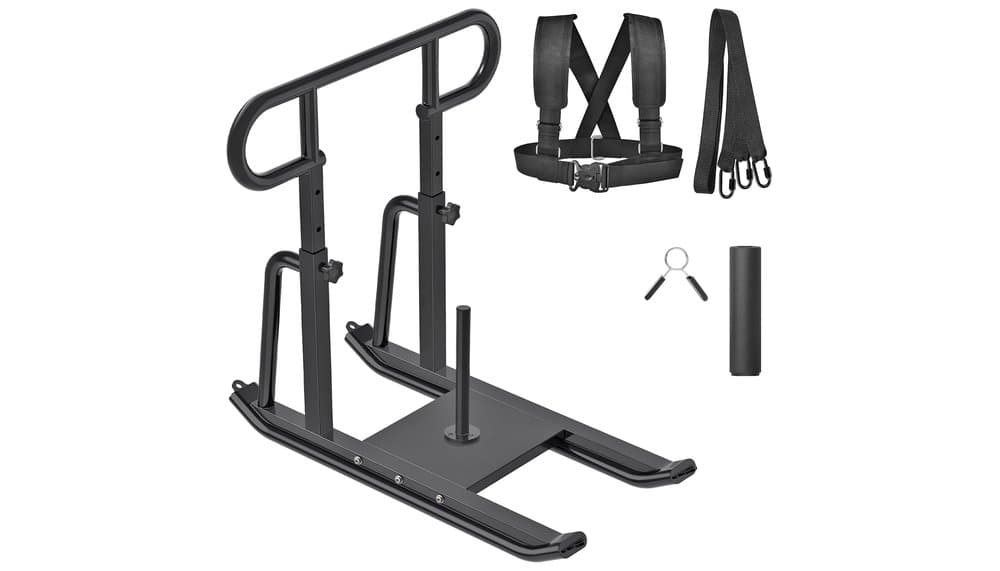
Its steel construction with black powder anti-rust finish is consistently praised. On paper, this robustness promises durability suited for heavy loads and intensive use, far from plastic models often perceived as toys. The compatibility with standard 1-inch and 2-inch plates is another major advantage. It allows for fine and unlimited load progression, a crucial point for simulating the increasing difficulty of an event like the sled push at the end of a HYROX race.
The versatility of the grips is also a strong argument. With its adjustable-height push handles, low handles, and lateral elliptical handles, the sled offers a great variety of working positions. This allows for targeting different muscle chains and adapting to various body types, a plus for group training or varied WODs. Finally, its multi-surface design, with a curved front to protect floors, theoretically allows training on grass, asphalt, or tartan, thus reproducing the changing conditions one might encounter.
Weak Points
Analysis of user feedback and usage contexts allows for identifying a few potential limitations, especially for competitive HYROX-oriented use.
The most frequent point of friction concerns the supplied harness. Several users describe it as basic, sometimes poorly designed, and limited to forward pulling. For varied or more comfortable pulling exercises, the community notes that an investment in a third-party harness (like a pulling belt) is often necessary. This is not a deal-breaking flaw, but it is an additional cost to anticipate for full use.
Next, although its robustness is an asset, it has a corollary: noise and impact on floors. On concrete or asphalt, testers emphasize that the sled can be very loud and potentially abrasive for delicate floors. This limits its use in urban environments or in gyms without appropriate protection (like a push sled mat). Finally, some reviews mention some flexibility in the tubes under very heavy loads or during extremely violent efforts. This does not affect the overall sturdiness according to feedback, but can give a less "massive" feel compared to high-end professional models.
Here, we dissect the performance of the Kipika Weight Sled against the implicit specifications of a HYROX athlete.
Adaptation to Specific Events
For the sled push and sled pull, the key events, the Kipika seems well-equipped. The adjustable handle height is a valuable asset for reproducing the exact position of the official HYROX machine and for working at different angles, thus variably engaging the quadriceps, glutes, and hamstrings. The ability to load heavy meets the need to develop the explosive power required at the start of each push. For farmers carries or other carrying exercises, the lateral handles offer an option, even though the product is not primarily designed for that.
Behavior Under Fatigue and Transitions
This is the heart of the event. Maneuverability is therefore key. The open frame and lack of superfluous elements on the Kipika are positive points: they reduce the risk of snagging during fast or poorly controlled movements under fatigue. The simplicity of changing loads (adding/removing plates) is also crucial for circuits where resistance must be quickly modified between stations. However, its empty weight of approximately 15 kg and its size can make it slightly less agile to move manually from one point to another than a more compact model, but this also contributes to its stability during effort.
Reliability Under All Conditions?Durability is non-negotiable for equipment intended for repeated and intense training. Feedback converges on the solidity of the construction and the quality of the rust-resistant finish. This suggests the Kipika can withstand impacts, heavy loads (well beyond 100 kg according to tests), and use on grass or gravel, without showing signs of premature weakness. This is a strong point for serious training.
Synthesizing available customer reviews and expert feedback reveals a clear consensus, with dominant positive trends and specific criticisms.
Recurring positive points revolve around three pillars. First, the build quality and sturdiness are highly praised. Users talk about a "robust", "solid", "well-built" product that inspires confidence even under heavy load. Second, the value for money is very often highlighted. It is described as a serious and durable option at an accessible price, often favorably compared to more expensive models. Finally, the versatility and effectiveness of workouts are emphasized. Athletes note progress in power, metabolic conditioning, and appreciate the variety of possible exercises.
The main criticisms focus on two aspects. The supplied harness is the most cited weak point. It is deemed impractical, of inferior quality to the sled itself, and limiting for pulling exercises. Many recommend replacing it with a dedicated belt. Next, the noise nuisance on hard surfaces is frequently mentioned. This is a common characteristic of most metal-skid sleds, but it limits possible usage locations without adjustments.
The overall impression is that of a reliable and effective product for serious training, whose main flaw (the harness) is easily circumvented. The high overall rating (4.3/5) confirms this satisfaction.
Conclusion
The Kipika Weight Sled Strength Training Equipment emerges from this analysis as a solid, versatile, and excellent value-for-money piece of equipment for the functional fitness athlete and HYROX practitioner. Its robust construction, compatibility with heavy loads, and multiple grips make it a suitable tool for specifically developing the explosive power and strength endurance required in competition.
Its adaptation to HYROX demands is overall good: it allows for effectively simulating the sled push/pull event, training under fatigue, and working on varied surfaces. Reservations mainly concern peripheral aspects: the supplied harness, poorly suited for intensive use, and the need to plan for a suitable surface or protection for delicate floors due to noise and abrasion.
In summary, if you are looking for a reliable, durable sled capable of supporting intense training without breaking your budget, the Kipika is a serious contender. For 100% optimized use, you will likely need to plan for the acquisition of a higher-quality pulling harness. It is an initial investment that, according to community feedback, should accompany you durably in preparing for your next HYROX races.
100% free and independent — All our articles are written independently, without any sponsorship. We may receive a commission if you make a purchase through our links, at no extra cost to you.