In the demanding world of HYROX, where performance is measured by the ability to chain together running, rowing, sled pushing, and load carrying under intense fatigue, recovery is not a luxury, it is a strategy. Active recovery tools have moved from accessory status to essential equipment. It is in this context that we analyze the Theragun Wave Roller Vibrating Foam Roller. This is not a simple foam roller; it is a technological tool that promises to combine classic myofascial pressure with vibration therapy. But does this promise hold up against the specific and brutal needs of a HYROX athlete? This is what we will dissect, based on technical specifications, community feedback, and expert analysis.
Strengths: Technology in the Service of Active Recovery
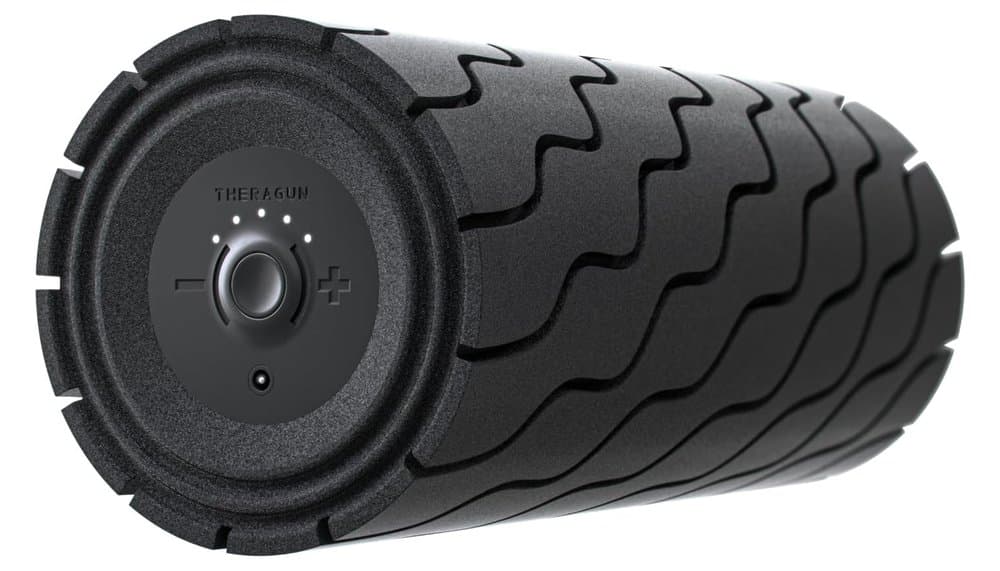
The Theragun Wave Roller immediately stands out due to its integrated approach. What interests us here is its potential for a functional athlete.
Its customizable vibration power is its main selling point. With five vibration levels controllable via the Therabody app, it offers an intensity range that, according to testers, is both powerful and nuanced. This allows for session adaptation: a low level for a light warm-up or a sensitive area (like shoulders after burpees), and max levels to tackle massive groups like quadriceps or hamstrings, heavily taxed during sled pushes or farmers carries.
Its exceptional portability is a major asset for the HYROX context. At 30 cm long and weighing 2.8 kg, it is significantly more compact and transportable than a traditional 90 cm roller. Users emphasize that it slips easily into a gym bag, making it a serious candidate for use during competition, in recovery phases between stations or after the event.
Finally, the Bluetooth connectivity and guided routines of the Therabody app transform self-massage from an approximate task into a structured session. For a tired athlete, not having to think and simply following a 5-minute program for the lower body is a non-negligible gain in time and efficiency.
Weaknesses: The Compromises of a Specialized Tool
Despite its innovations, the Wave Roller has limitations that the HYROX community must consider.
Its limited versatility for small areas is its main weakness. Its cylindrical shape and reduced length, while practical for transport, make it less effective for targeting precise points like the piriformis, neck muscles, or forearms. Experts note that for very localized "trigger point" work, tools like the Wave Duo (double-ball shaped) or a simple lacrosse ball may be more appropriate.
Discomfort from the texture is a shared point. The EVA foam, although high density, is described by some users as softer than that of a classic roller. Combined with the grooved texture, it may offer less traction and "biting" pressure needed to release very tight fascia, a frequent state after a series of farmers carries or sled pulls.
Finally, a recurring point in customer feedback is long-term reliability. Several reviews report premature failures (such as stopping working after a short period), which raises questions about the device's robustness in the face of intensive and regular use, typical of HYROX training.
Let's now evaluate this product against the specific requirements of our discipline.
Adaptation to events and intense fatigue:
The Wave Roller excels at recovery of large muscle groups immediately after exertion. After a rowing station or a series of burpees, the shoulders and back are tense. Its vibrating surface can help quickly release these areas more deeply than simple passive stretching. For the legs, devastated by runs, sled pushes, and carries, the vibration seems, according to feedback, to accelerate the sensation of muscle release, potentially beneficial for quick transitions. However, its format makes it less ideal for use during competition on specific cramp points.
Performance during quick transitions:
This is where its portability shines. Its size allows it to be slipped into a bag and used quickly during allocated recovery times. The 180-minute battery life is more than sufficient for several competitions. The app, with its short routines, fits perfectly with the need for effective intervention in a limited time. We note that it is a tool designed for structured and rapid recovery, aligned with the time constraints of HYROX.
Comparison with competition requirements:
HYROX demands resilience and an ability to manage discomfort. The Wave Roller, with its vibrations, can make the myofascial recovery process less painful than a traditional roller, which is a non-negligible psychological plus in a state of fatigue. However, it does not replace the deep, static pressure of a firm 90 cm roller or the specific release of a tool like a ball. It is rather a technological complement to a complete recovery kit, ideal for phases of overall release and muscle "flushing".
Technical Specifications
Feature
Detail
Product Name
Theragun Wave Roller Vibrating Foam Roller
Dimensions
30 cm (L) x 12 cm (Ø)
Weight
2.8 kg
Material
High-density hypoallergenic EVA foam
Texture
Asymmetrical silicone grooves ("wave" texture)
Features
Motorized vibration, Bluetooth connectivity
Vibration Levels
5, adjustable via the Therabody app
Battery Life
Up to 180 minutes
Contents
Wave Roller, carrying case, charger
What Users and Experts Say
A synthesis of customer feedback and expert analysis paints a clear consensus.
Recurring positive points are:
Effectiveness and power: Users report rapid muscle relief and a deep sensation of release, especially on large groups like the back and legs.
Comfort of use: The vibration/pressure combination is widely described as more pleasant and less "painful" than a classic roller.
Portability and design: Its compact size and carrying case are consistently praised.
App and routines: The Therabody app is seen as a real plus, effectively guiding the user.
Highlighted negative points or criticisms are:
Durability and reliability: Several reports mention premature failures, casting a shadow on the product's longevity.
Value for money: Its high cost is often questioned, with some wondering if the added benefit justifies the investment compared to a standard roller.
Precision limit: Many note that it is less effective for small areas (deep hips, neck, forearms) than more targeted tools.
Noise: Although designed to be quiet, a hum is audible at the highest speeds.
Functional fitness experts acknowledge its innovation and utility for overall recovery, but insist that it complements rather than replaces a range of myofascial release tools.
Conclusion
The Theragun Wave Roller Vibrating Foam Roller is a sophisticated recovery tool that finds a legitimate place in the HYROX athlete's arsenal. Its main advantage lies in its ability to offer active, powerful, and structured recovery for large muscle groups, all in a remarkably portable format. For managing the cumulative fatigue of events and optimizing recovery times between stations, it represents a technological and practical solution.
However, it is not a panacea. Its price, questions about its durability, and its limitation for precision work make it an investment to consider with lucidity. We see it as an excellent primary tool for general recovery phases post-training or post-competition, particularly effective for legs and back. For complete myofascial work, it will likely need to be paired with more targeted tools (ball, longer and firmer roller).
Ultimately, if you are looking for a high-end, portable, and connected recovery device to optimize your overall muscle release within the demanding framework of HYROX, the Wave Roller is a serious and high-performing option. But if your budget is limited or you need a single, ultra-versatile tool, a traditional foam roller and a massage ball might remain a more complete and economical foundation.
100% free and independent — All our articles are written independently, without any sponsorship. We may receive a commission if you make a purchase through our links, at no extra cost to you.