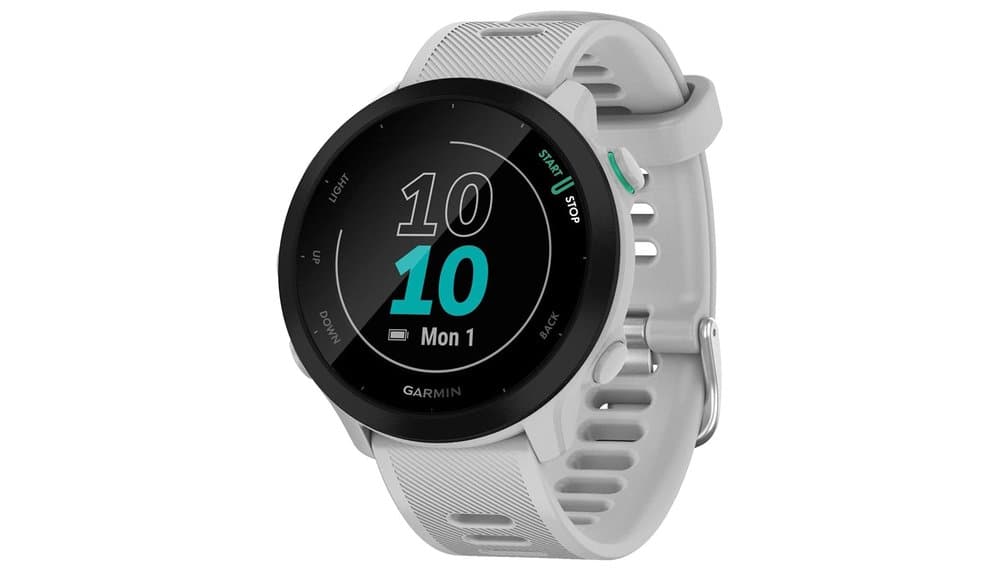
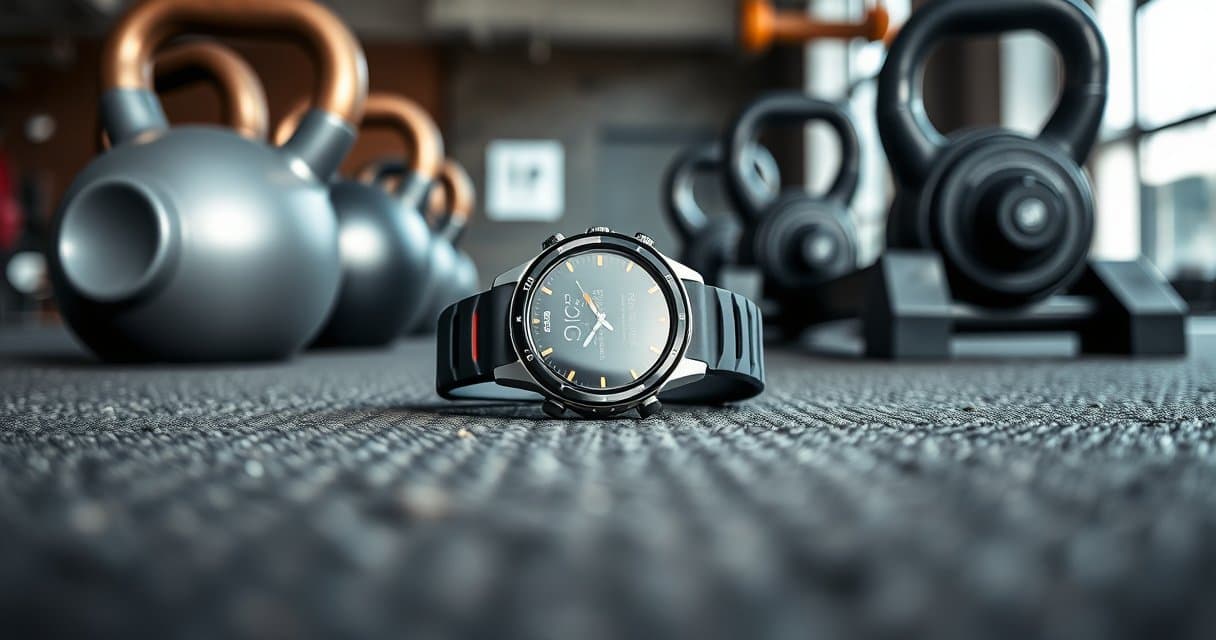
The GPS watch has become an almost indispensable tool for the modern athlete, capable of quantifying effort and structuring progress. In the demanding world of HYROX, where running, rowing, pull-ups, and load carrying are performed under intense physiological stress, equipment choice is crucial. The Garmin Forerunner 55 presents itself as an entry-level GPS watch, but is it suited to the rigors of this hybrid competition? We have analyzed its technical specifications and cross-referenced community feedback to assess its relevance in the face of HYROX's specific demands.
Potential Strengths for HYROX
Battery Life and Robustness Suitable for the Task
On paper, the specifications of the Forerunner 55 promise up to 20 hours of battery life in GPS mode and a water resistance rating of 5 ATM (50 meters). What interests us here is its ability to last a full day of training, or even a complete competition, without dying. According to user feedback, the battery is indeed a strong point, with consumption of around 10% per hour in GPS mode. Its construction seems robust and its water resistance protects it from heavy sweating and splashes during rowing stations or quick washes.
Solid Running Metrics and 24/7 Heart Rate Monitoring
The core competency of this watch is running. It integrates advanced functions like PacePro (pace management based on elevation) and race time predictions. For HYROX, where the strategic 1 km running segments are repeated, these tools can prove valuable for effort management. The Garmin Elevate Gen 3 heart rate sensor provides continuous data, allowing you to track heart rate during effort and recovery phases between stations. The Body Battery function (energy reserve estimation) is also cited by reviewers as a useful indicator for managing overall fitness.
Versatility of Activity Profiles and Ease of Use
With its 17 built-in activity profiles, including Running, Cycling, Pool Swimming, Yoga, and HIIT, the Forerunner 55 theoretically covers several HYROX disciplines. Navigation via five physical buttons is unanimously praised by experts as an advantage in situations of intense fatigue: you can operate the watch with sweaty, gloved hands, or during transitions, without having to rely on a potentially unresponsive touchscreen.
Weaknesses and Limitations for HYROX
Lack of Specific Activity Profiles and Advanced Strength Metrics
This is likely the most obvious limitation. The Forerunner 55 does not have a dedicated profile for rowing, sled push/pull, or farmers carries. You will therefore have to use a generic profile like "Cardio" or "HIIT," meaning specific data (rower power, valid pull-up count) will not be recorded accurately. Unlike higher-end models, it lacks sensors to measure running power or vertical oscillation, metrics that are nevertheless interesting for analyzing running efficiency under fatigue.
A Screen and Interface That May Be Limiting
Reviewers note that the screen, while readable, has a fairly basic resolution. In the middle of a competition, under variable lighting and with perception altered by fatigue, the immediate clarity of data could be a factor. The interface, while simple, is not as customizable as on other Garmin models to display, for example, an ultra-minimalist screen with only the timer and heart rate during a strength exercise.
Wrist Heart Rate Responsiveness During Very High-Intensity Intervals
While the heart rate sensor is considered reliable for steady efforts, several expert tests highlight that a chest strap remains more responsive for high-intensity interval sessions. However, HYROX is a series of short, intense efforts. It is therefore possible that heart rate measurement may have a slight lag during rapid transitions between running and strength stations, which could skew the calculation of effort zones and displayed recovery time.
Detailed Analysis: The Forerunner 55 in the Heat of HYROX Action
During the Run
This is its specialty. The multi-system GPS (GPS, Glonass, Galileo) is described as fast and accurate, essential for precisely measuring the 1 km segments indoors (stadium) or outdoors. The PacePro function could be configured to maintain a precise target pace for each running portion, a valuable cognitive aid when mental fatigue sets in.
During Functional Fitness Stations
This is where the compromises appear. For the rower, the watch will record duration, heart rate, and estimated calories, but not distance or split-time/500m natively. For sled pushes, burpees, or farmers carries, it will only time the station and record the heart rate response. The community notes that its lightness (37g) and small case are assets for not hindering during wide-ranging movements or carries.
Recovery and Training Load Management
This is an indirect strength. Functions like suggested recovery time, sleep and stress tracking, and the Body Battery are valuable tools in training for a HYROX athlete. They help avoid overtraining and plan quality sessions. According to feedback, this data, although estimative, provides a reliable trend to rely on.
Key Technical Specifications
Feature
Detail for the Garmin Forerunner 55
Screen
1.04 inches, color, non-touch
GPS
Built-in multi-system (GPS, Glonass, Galileo)
Battery Life
Up to 2 weeks (watch) / 20h (GPS mode)
Water Resistance
5 ATM (50 m)
Heart Rate Sensor
Garmin Elevate™ Gen 3 (wrist)
Activity Profiles
17 built-in (Running, Cycling, Pool Swim, HIIT, Yoga, etc.)
Training Functions
Garmin Coach, PacePro, Race Predictor, Recovery Time
Health Tracking
24/7 Heart Rate, Stress, Sleep, Body Battery, Fitness Age
Connectivity
Bluetooth, Connect IQ (limited customization)
Buttons
5 physical buttons
Weight
Approximately 37 grams
What Users and Reviewers Say
The synthesis of customer reviews and expert tests paints a clear consensus.
The recurring positive points are:
Excellent battery life and fast charging.
Remarkable GPS accuracy for its segment.
Exceptional comfort daily and during exercise due to its lightness.
Simplicity and reliability of the button interface.
Feature-to-price ratio considered excellent for a runner.
The often-mentioned criticisms or limitations:
The screen is sometimes described as "dated" in terms of sharpness.
Lack of onboard music and contactless payment (Garmin Pay).
Some regret the absence of mapping and a barometric altimeter (less critical for indoor HYROX).
Customization via Connect IQ is more limited than on higher-end models.
In the context of HYROX, no feedback specifically mentions its use in competition, confirming its positioning as a "generalist" sports tool rather than one specialized for high-level functional fitness.
Conclusion: A Good Training Companion, a Reliable Timer in Competition
The Garmin Forerunner 55 is not the ultimate, dedicated watch for the HYROX athlete. It will not provide advanced metrics on your rower performance or load carrying. However, for the amateur or intermediate HYROX athlete, it represents an excellent entry point.
Its primary role will be that of an ultra-reliable GPS tracker and timer for the running segments, and a heart rate monitor allowing you to quantify the overall intensity of effort during training and competition. Its robustness, battery life, and ease of use under stress make it a tool that won't let you down.
If you are looking for a first watch to structure your running preparation, track your overall load, and have a reliable tool on race day, the Forerunner 55 is a very smart choice. If your expectations lean towards the fine analysis of each specific HYROX movement, you will need to look towards higher-end models, from Garmin or other brands, which offer dedicated activity profiles and sensors.
100% free and independent — All our articles are written independently, without any sponsorship. We may receive a commission if you make a purchase through our links, at no extra cost to you.